
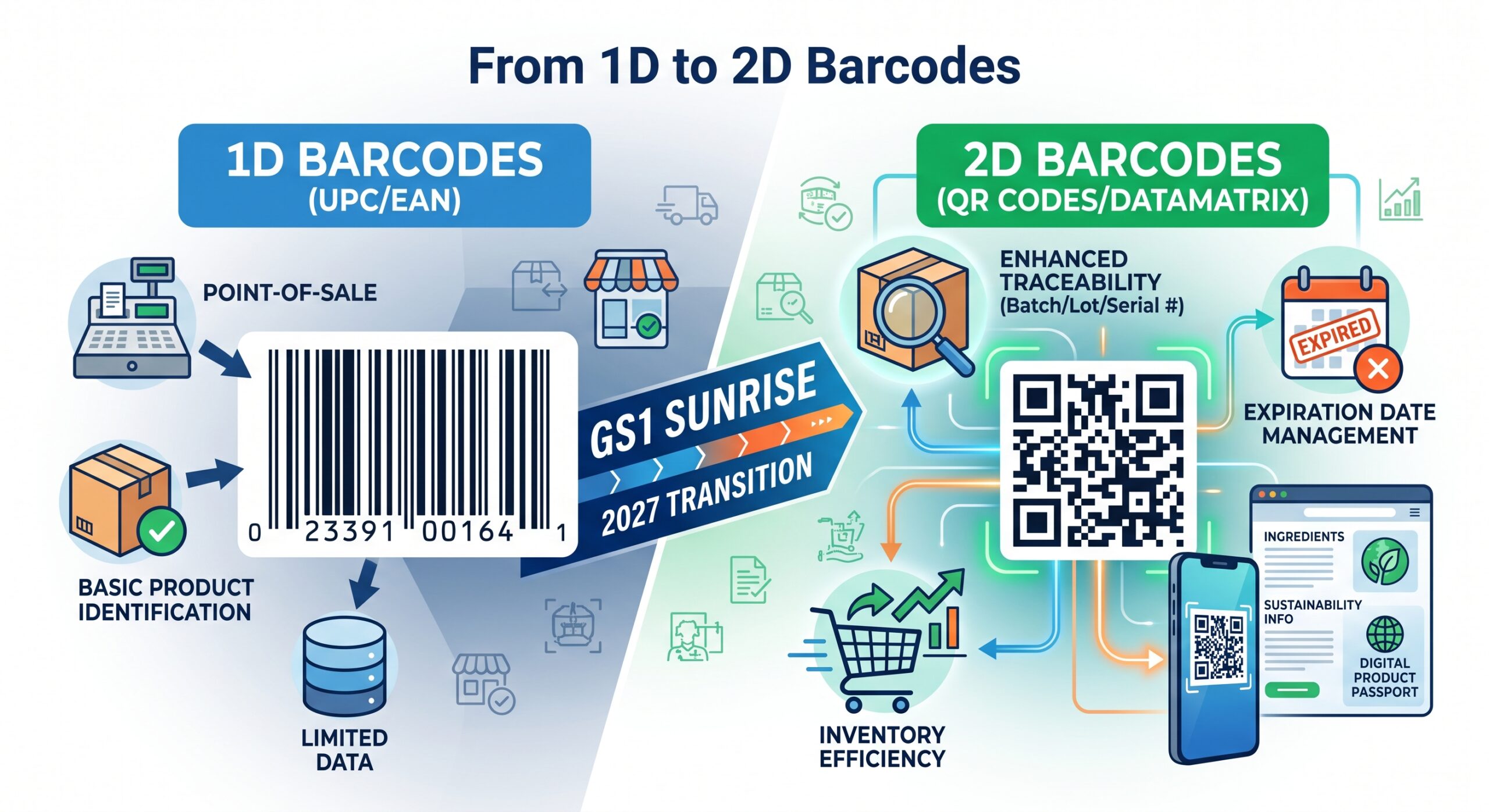
From 1D to 2D Barcodes: Benefits, Risks, and the Wider Effects of the Sunrise 2027 Transition
Abstract
The global barcode system is undergoing an important transformation as retailers, manufacturers, packaging companies, and logistics providers prepare for wider use of two-dimensional barcodes (Hutton, 2026). Traditional one-dimensional barcodes, including the Universal Product Code and European Article Number, have supported retail and supply-chain operations for decades. However, they generally identify a product rather than communicating detailed product-specific information (GS1 US, n.d.). Two-dimensional formats, including QR Codes and GS1 DataMatrix, can support richer information such as batch numbers, expiration dates, serial numbers, and digital links (Advanced Automation Inc., 2026).
The GS1 Sunrise 2027 initiative encourages retail point-of-sale systems to become capable of reading and processing appropriate 2D barcodes by the end of 2027 (Quick Response Code, 2026). Major global retailers—including Walmart, Target, Tesco, and Kroger—are actively driving this transition by setting supplier requirements and updating their point-of-sale infrastructure (TrackVision, 2026). While the transition may improve traceability, recall management, inventory processes, consumer information, and digital engagement, implementation also imposes significant burden regarding equipment, packaging, software, data-governance, cybersecurity, privacy, and operational costs.
Furthermore, the benefits of 2D barcodes depend on the quality and continued availability of the systems and data behind them. Critics and cautious industry analysts argue against rapid or universal adoption due to potential technical vulnerabilities, high compliance burdens for smaller suppliers, increased packaging layout challenges, and risks associated with digital infrastructure dependence. This article evaluates both sides of the transition and argues that organizations should adopt 2D barcodes selectively, using evidence-based pilots and maintaining 1D compatibility where the additional functions of 2D technology do not justify the cost or complexity.
- Introduction
The introduction of the commercial barcode substantially changed retail operations by enabling products to be identified automatically at checkout. The first commercial Universal Product Code scan took place in Ohio in 1974. Since then, 1D barcodes have become a basic component of retail, manufacturing, healthcare, transportation, and logistics systems, reducing manual data entry and providing a standardized connection between a physical product and a record in an information system.
Despite their reliability and widespread acceptance, conventional 1D barcodes have limited data capacity. Formats such as UPC and EAN normally act as product-identity keys. Additional information, including price, product description, inventory level, and supplier data, is generally retrieved from a separate database. By contrast, 2D barcodes encode information across horizontal and vertical dimensions and can therefore accommodate substantially more data within a relatively compact symbol.
GS1 Sunrise 2027 is accelerating attention to this difference. The initiative seeks point-of-sale readiness for 2D barcodes by the end of 2027, allowing qualifying GS1 2D symbols to be processed in retail settings. Major retailers like Walmart and Target are actively building 2D scanning capability into their operations and communicating requirements to their supplier networks (TrackVision, 2026). It does not, however, mean that UPC and EAN barcodes will suddenly become invalid; 1D and 2D barcodes are expected to coexist during the transition.
The central question is therefore not whether 2D barcodes have greater technical capacity. They clearly do. The more important question is whether that additional capacity creates sufficient operational and social value to justify the investment, coordination, and new forms of risk introduced by the transition.
- The Technological Evolution from 1D to 2D
A 1D barcode uses differences in the width and spacing of parallel lines to encode information (such as UPC, EAN, Code 39, and Code 128). These formats remain effective when an organization needs a fast, standardized method of identifying a product, shipment, asset, or record. Their simplicity has contributed to broad interoperability and reliable performance across established retail and logistics environments.
A 2D barcode instead represents data through a matrix of squares, dots, or other geometric patterns, such as QR Codes, DataMatrix symbols, and PDF417. Conventional 1D barcodes typically store approximately 20 to 25 characters, whereas 2D formats may hold substantially more, depending on the format, dimensions, error-correction settings, and type of encoded information.
In many commercial applications, a code contains a standardized product identifier and a structured digital address. Through GS1 Digital Link, the physical product can be connected to online information that serves different users, including retailers, consumers, logistics providers, and regulators. The strategic value of 2D barcodes does not arise solely from the amount of data printed on a package, but also from their ability to function as gateways to digital records that can be updated without necessarily reprinting the barcode. However, this also makes the system dependent on external databases, websites, resolvers, software, and network services.
- Sunrise 2027 and Industry Readiness
According to GS1 US, Sunrise 2027 represents a milestone in the transition toward data-rich barcodes (GS1 US, n.d.). GS1 US recommends a gradual “crawl, walk, run” approach. At the first stage, brands may add suitable 2D barcodes while retailers install optical scanners capable of extracting the Global Trade Item Number at checkout. Later stages may introduce additional data such as product variants, expiration dates, and production information, followed by more advanced consumer and internal operational applications.
The initiative is an industry-led readiness target rather than a legal prohibition against 1D codes. Major retailers—including Walmart, Target, Carrefour, Tesco, Woolworths, Kroger, Dillard’s, and Safeway—are setting supplier requirements and driving practical adoption (TrackVision, 2026). Consequently, organizations should distinguish among legal requirements, GS1 standards, retailer-specific mandates, and optional business enhancements when developing their implementation plans.
- Arguments Supporting the Adoption of 2D Barcodes
- Improved Product Traceability: GS1-compliant symbols can carry or connect users to information such as batch numbers, lot numbers, expiration dates, and serial identifiers, helping organizations isolate affected inventory more accurately during incidents.
- Expiration-Date and Inventory Management: Encoding expiration or production information supports stock rotation, automated discounts for products nearing expiration, and fast flagging of recalled goods to support waste-reduction objectives.
- Greater Consumer Access to Information: Web-enabled 2D barcodes provide consumer access to ingredients, allergens, sourcing, certifications, instructions, recycling, and sustainability details without cluttering physical packaging space.
- Digital Product Passports and Sustainability Information: 2D barcodes offer seamless pathways to digital product passports detailing material composition, recycled content, and production sources, which is vital for complex or flexible packaging.
- Interaction with Complementary Technologies: 2D codes function well alongside RFID and near-field communication (NFC) technologies, filling the gap for general, cost-effective individual item tracking where bulk scanning or interactive elements are secondary.
- Arguments Against Rapid or Universal Adoption and Criticisms
Despite the momentum behind the Sunrise 2027 initiative, a range of technical, financial, and operational criticisms have emerged against rapid or universal adoption:
- Disproportionate Financial Burden on Smaller Suppliers: Critics point out that upgrading packaging artwork, printers, machine-vision verification systems, enterprise resource planning (ERP) systems, and software data structures imposes heavy financial and resource burdens, which can disproportionately impact small and medium-sized enterprises (SMEs) that lack the capital of retail giants like Walmart or Target.
- Equipment and Implementation Costs: Beyond suppliers, retailers and manufacturers face high capital expenditures to replace or upgrade legacy laser scanners with image-based readers and point-of-sale software capable of parsing complex digital links.
- Dual-Marking Complexity and Label Real Estate: Maintaining both an existing UPC/EAN symbol and a 2D barcode simultaneously during the transition increases packaging layout constraints, consumes valuable design space, and raises the risk of printing errors or scanning interference at checkout.
- Print-Quality and Substrate Vulnerabilities: 2D barcodes are highly sensitive to physical environmental factors. Plastics and flexible packaging elements—such as reflective metallized films, high-gloss surfaces, transparent wraps, wrinkles, folds, and low contrast—frequently introduce readability issues that do not affect traditional linear barcodes (Hutton, 2026).
- Cybersecurity Risks and Malicious Redirection: Because consumer-facing QR codes direct smartphone cameras to web destinations, they introduce exposure to counterfeit labels, physical sticker overlays, malicious redirection, expired domains, and unauthorized data tampering.
- Privacy and Consumer Tracking Concerns: Web-enabled codes allow businesses to measure user scans and digital engagement. Without rigorous data minimization, unintended web-data collection regarding approximate locations, timestamps, and cookies can occur without transparent user consent.
- Fragility of Digital Infrastructure Dependence: Shifting information online means that if web domains expire, networks fail, or cloud servers experience downtime, the digital link breaks entirely, stripping the code of its advanced utility.
- The Digital Divide and Accessibility Barriers: Requiring consumers to possess a smartphone, stable internet connectivity, and digital literacy to access essential product information creates exclusions for populations with accessibility needs or technological limitations.
- Perspective Comparison: USA vs. Global Effects and Processes
While Sunrise 2027 is a unified framework, its application diverges significantly between the United States and international markets (such as the European Union and Asia-Pacific):
- Primary Catalysts: In the U.S., the transition is driven commercially by dominant retailers (e.g., Walmart, Target) setting supply-chain requirements. Globally—especially in Europe—the transition is heavily accelerated by statutory mandates like the EU’s Digital Product Passport (DPP) framework under the Ecodesign for Sustainable Products Regulation (ESPR).
- Operational Goals:S. efforts focus primarily on inventory precision, loss prevention, and compliance with food traceability guidelines like FSMA Rule 204. Global efforts heavily emphasize circular economy transparency, material tracking, and sustainability compliance.
- Implementation & Packaging:S. markets rely heavily on dual-marking (coexistence of UPC and 2D codes) to minimize supply chain friction. Conversely, global markets leverage 2D codes immediately to replace bulky multi-language statutory text on packaging with space-saving cloud-linked identifiers.
- Data & Privacy Frameworks:S. adoption utilizes web-linked codes for marketing and loyalty data harvesting, whereas global deployments (particularly under EU GDPR) face strict data-minimization mandates preventing unauthorized telemetry tracking.
- A Balanced Adoption Strategy
The evidence supports gradual, use-case-based adoption rather than an unconditional replacement of every 1D barcode. Organizations should evaluate strategic questions regarding what specific problem a 2D barcode solves, whether existing systems can utilize the data, whether benefits exceed total implementation costs, and how consumers without digital access will obtain essential information.
- Conclusion
The transition from 1D to 2D barcodes is best understood as an expansion of product-information infrastructure rather than the straightforward replacement of lines with squares. While GS1 Sunrise 2027 and major retail adopters provide an important industry milestone for point-of-sale readiness, 2D barcodes introduce distinct costs, physical printing challenges, data-governance responsibilities, cybersecurity exposure, and digital-access concerns. The strongest approach is selective and evidence-based, ensuring 1D compatibility is preserved where the additional functions do not justify the cost or complexity.
References
Advanced Automation Inc. (2026). GS1 Sunrise 2027: What the 2D barcode transition actually means for your operation. Advanced Automation. https://www.advanced-automationinc.com/learning-center/gs1-sunrise-2027-what-the-2d-barcode-transition-actually-means-for-your-operation/
GS1 US. (n.d.). What is GS1 Sunrise 2027? GS1 US. https://www.gs1us.org/industries-and-insights/by-topic/sunrise-2027
Hutton, D. (2026). Flexible packaging industry faces critical 2D barcode transition. PlasticsToday. https://www.plasticstoday.com/packaging/flexible-packaging-industry-faces-critical-2d-barcode-transition
Quick Response Code. (2026). GS1 Sunrise 2027: The QR code mandate explained. Quick Response Code Resources. https://quickresponsecode.com/resources/gs1-qr-code-2027/
TrackVision. (2026). GS1 Sunrise 2027 compliance deadlines: Is your supply chain ready? TrackVision Insights. https://trackvision.ai/blog/2026-03-27-gs1-sunrise-2027-compliance-deadlines/
