
Policy and Technological Strategies for Reducing Microplastic Pollution
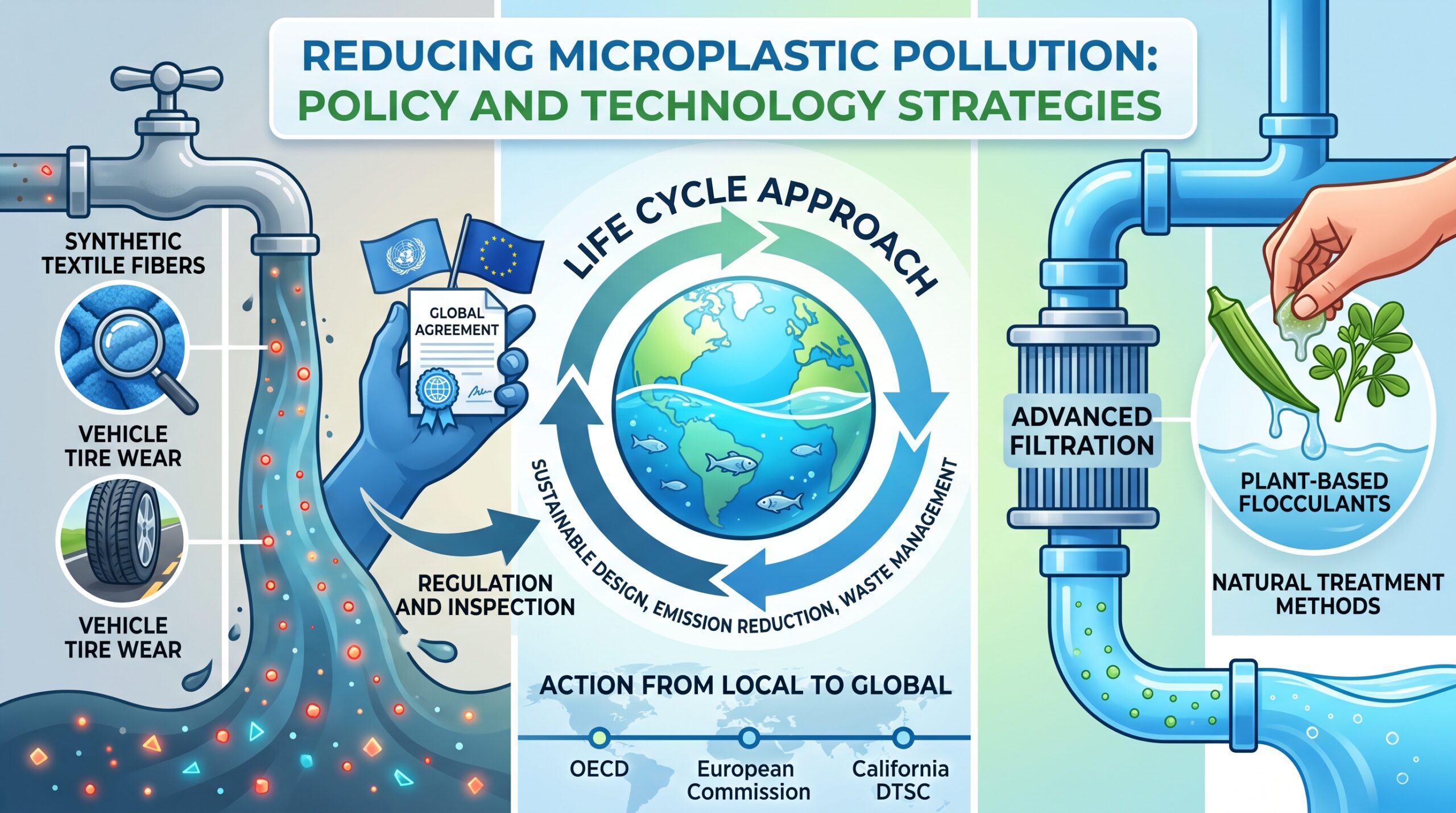
While significant scientific uncertainties remain regarding the long-term environmental and health impacts of microplastic exposure, policymakers and researchers have increasingly focused on strategies to reduce environmental emissions and improve plastic lifecycle management. The Organisation for Economic Co-operation and Development (OECD, 2021) identifies microplastic pollution as a major environmental challenge requiring coordinated international policy responses. These efforts have contributed to ongoing negotiations toward a legally binding global agreement on plastic pollution under the framework of the United Nations Environment Programme (UNEP).
A major source of microplastic emissions originates from everyday consumer products and infrastructure systems. OECD reports identify synthetic textiles and vehicle tires as important contributors, releasing microfibers and particles during normal use. Because these emissions occur continuously and diffusely, they present challenges for conventional waste-management systems and environmental controls.
To address these challenges, the OECD recommends a lifecycle-based approach that includes improved product design, emission reduction strategies, filtration technologies, and upgrades to wastewater treatment systems. Such approaches aim to reduce microplastic generation at multiple stages, including production, consumption, use, and disposal.
Emerging research has explored innovative technologies for microplastic removal. One promising area involves the use of plant-derived polysaccharides as environmentally sustainable flocculants capable of binding and removing microplastic particles from water. Srinivasan et al. (2025) demonstrated that polymers derived from okra and fenugreek successfully removed substantial quantities of microplastics from freshwater, groundwater, and seawater samples under laboratory conditions. However, scalability, cost-effectiveness, and real-world performance require further investigation before widespread adoption.
The European Commission has introduced regulatory measures focused on reducing both intentionally added microplastics and unintentional environmental emissions. These policies include restrictions on certain products containing intentionally added microplastics, manufacturing requirements, environmental monitoring initiatives, and expanded reporting obligations.
In the United States, California’s Department of Toxic Substances Control (DTSC) has proposed adding microplastics to the Safer Consumer Products Candidate Chemicals List to support future evaluation of products that may contribute to microplastic generation.
Counterarguments and Implementation Challenges
Despite growing support for regulatory and technological interventions, many proposed mitigation strategies remain in early stages of implementation. Real-world performance may differ significantly from laboratory results due to environmental variability, infrastructure limitations, and operational constraints.
Technological solutions alone may also be insufficient to address global-scale plastic pollution. Significant investment is required to upgrade wastewater systems, implement advanced filtration technologies, and redesign consumer products. Differences in economic capacity and infrastructure between countries may further limit uniform adoption.
Recent studies on bio-based coagulants highlight additional challenges, including variability in raw materials, inconsistent performance across microplastic types, and reduced efficiency for smaller particles. These limitations suggest that natural treatment agents are more likely to complement rather than replace existing technologies.
Environmental trade-offs must also be considered, as some mitigation systems may require high energy input or generate secondary waste streams. Therefore, both environmental impact and operational sustainability must be evaluated when assessing potential solutions.
Conclusion
Reducing microplastic pollution will require a combination of regulatory action, technological innovation, infrastructure improvements, sustainable product design, and international collaboration. A lifecycle-based approach that prioritizes prevention, supported by effective treatment and remediation technologies, remains central to long-term environmental management efforts.
Continued research and policy development will be essential for translating promising strategies into scalable, real-world solutions.
References
Badawi, A. K., Hasan, R., & Ismail, B. (2025). Sustainable coagulative removal of microplastic from aquatic systems: Recent progress and outlook. RSC Advances, 15, 25256–25273. https://doi.org/10.1039/D5RA04074D
California Department of Toxic Substances Control. (2025). Addition of microplastics to the Safer Consumer Products Candidate Chemicals List. California Environmental Protection Agency. https://dtsc.ca.gov
European Commission. (2025). Restricting intentionally added microplastics under REACH. European Commission. https://environment.ec.europa.eu
Organisation for Economic Co-operation and Development. (2021). Policies to reduce microplastics pollution in water. OECD Publishing. https://doi.org/10.1787/bc4ad079-en
Organisation for Economic Co-operation and Development. (2021). Policies to reduce microplastics pollution: Focus on textiles and tyres. OECD Publishing. https://www.oecd.org
Srinivasan, R., Bhuju, R., Chraibi, V., Stefan, M. C., Hien, N., Ustundag, D., Gill, J. L. N., Rasmussen, N., Saurenmann, B., Bracerra, J., Fowler, M., White, H., & Azadah, M. (2025). Fenugreek and okra polymers as treatment agents for the removal of microplastics from water sources. ACS Omega, 10(15), 14640–14656. https://doi.org/10.1021/acsomega.4c07476
United Nations Environment Programme. (2024). Intergovernmental Negotiating Committee on plastic pollution: Progress toward a global plastics treaty. https://www.unep.org
