The Global Plastics Treaty: Why Decision Rules Shape Long-Term Ambition
As governments approach the resumed UN’s Intergovernmental Negotiating Committee on Plastic Pollution Session (INC-5.4) (planned for 13–24 March 2027), negotiations focus on high-profile debates: capping primary plastic production, dividing implementation financing, and restricting hazardous chemicals (Cordano, 2026b; INC Secretariat, 2026). However, the long-term success of the treaty rests less on initial product restrictions than on its procedural architecture—the rules governing decision-making, amendments, and technical annexes (Carlini & Bonacini, 2026).
Core Structural Challenges
Production & Scope: While the “August 2026 Aid to Negotiations” contains no standalone production-control article, production appears in bracketed preliminary language (Cordano, 2026b). Major oil-producing states and ambition-focused coalitions remain deeply divided over whether upstream limits fall within the UN mandate (Agence France-Presse, 2026; Earth Negotiations Bulletin, 2025).
Financing & Burden-Sharing: Developing economies and donor nations disagree on how implementation costs should be distributed, threatening compliance for lower-income states (Earth Negotiations Bulletin, 2025).
Regional Precedents: Regional frameworks—such as the European Union’s REACH microplastics restriction (Regulation EU 2023/2055)—demonstrate that major markets can move faster than global consensus, but cannot replace universally harmonized standards (European Commission, 2023a, 2023b).
The Procedural Trade-Off: Consensus vs. Adaptability
To ensure the treaty remains viable over decades, negotiators must separate three distinct decision-making pillars:
- Treaty Adoption: The voting threshold required to adopt the initial instrument.
- Formal Amendments: Procedures governing structural changes to core articles post-entry into force.
- COP Decisions & Annex Updates: Mechanisms allowing a future Conference of the Parties to update technical lists and safety thresholds.
Approach | Strategic Advantages | Primary Risks |
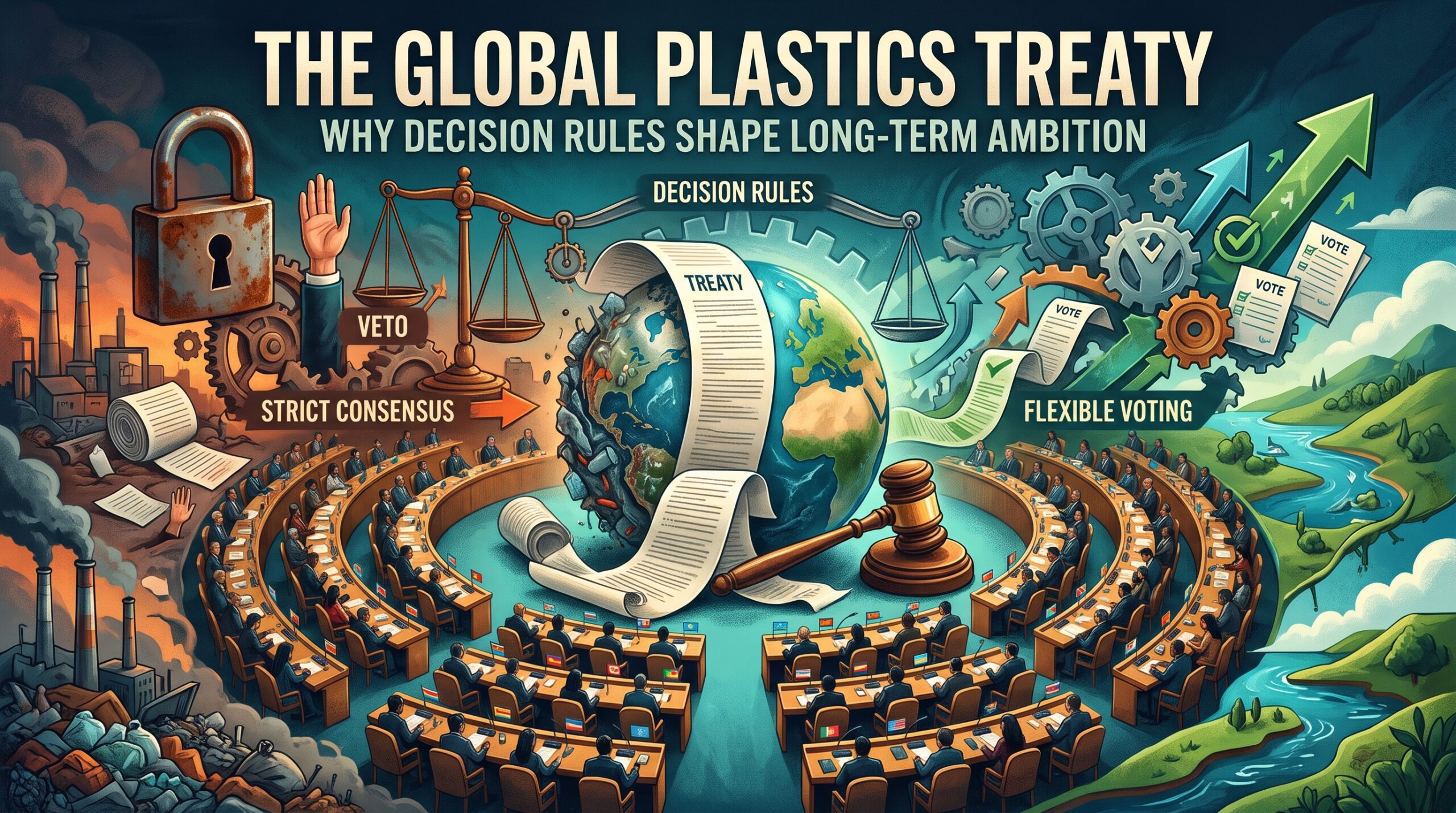
Strict Consensus | Maximizes initial political legitimacy and agreement from major producing and exporting nations. | Creates a de facto veto for single holdout states, paralyzing future ambition as evidence evolves. |
Qualified Majority / Flexible Voting | Ensures the treaty can adapt, update technical annexes, and overcome political stalemates. | Risks alienating dissenting states, potentially leading to lower ratification rates or opt-outs. |
Strategic Recommendations
For Governments: Clarify national positions ahead of the January 2027 Nairobi intersessional meetings by separating COP decision rules from core treaty amendments. Pursue a hybrid model maintaining consensus for foundational matters while utilizing qualified-majority voting (QMV) as a safety valve for technical annex updates.
For Business & Industry: Weigh the compliance costs of fragmented national regulations against harmonized global standards, and propose constructive upstream alternatives (e.g., product-design standards and extended producer responsibility) (Carlini & Bonacini, 2026).
For Civil Society: Track successive iterations of the Aid to Negotiations to monitor how bracketed text and decision-making powers migrate over time (United Nations Environment Programme, 2026).
Conclusion
The ultimate test of the global plastics treaty will not be measured solely by how ambitious its initial targets appear on paper the day it is signed. History demonstrates that groundbreaking environmental accords—from the Montreal Protocol to the Paris Agreement—succeed or fail based on their institutional resilience. If negotiators lock themselves into rigid consensus rules that grant a single holdout state an unyielding veto over future updates, even the most stringent initial product bans will atrophy as new pollutants emerge and industrial technologies evolve.
Ultimately, building a durable framework requires acknowledging the inherent tension between broad initial participation and long-term adaptability. By deliberately separating foundational adoption from flexible, majority-supported mechanisms for technical annexes, governments can craft an agreement that is politically viable today yet capable of tightening the screws over the coming decades. Without this forward-looking procedural architecture, the treaty risks becoming a static artifact of a single diplomatic moment rather than a dynamic engine for planetary health.
References
Agence France-Presse. (2026, October 1). Plastic treaty talks chair sees deal possible in March. Bangkok Post.
Carlini, G., & Bonacini, C. (2026). What to watch for in the new “no surprises” plastics treaty draft. Center for International Environmental Law. https://www.ciel.org/what-to-watch-no-surprises-plastics-treaty-draft/
Cordano, J. (2026a, August 8). Explanatory note to the Aid to Negotiations. United Nations Environment Programme.
Cordano, J. (2026b, August 8). Aid to Negotiations. United Nations Environment Programme, Intergovernmental Negotiating Committee on Plastic Pollution.
Earth Negotiations Bulletin. (2025, August 18). Summary of the Resumed Fifth Session of the Intergovernmental Negotiating Committee to Develop an International Legally Binding Instrument on Plastic Pollution, including in the Marine Environment: 5–15 August 2025. International Institute for Sustainable Development, 36(43).
European Commission. (2023a). Commission Regulation (EU) 2023/2055 of 25 September 2023 amending Annex XVII to Regulation (EC) No 1907/2006 as regards synthetic polymer microparticles. Official Journal of the European Union, L 238/67. https://eur-lex.europa.eu/legal-content/EN/TXT/?uri=CELEX%3A32023R2055
European Commission. (2023b). Restriction of microplastics intentionally added to products.
INC Secretariat. (2026, June 2). Save the Date: Fourth part of the fifth session of the Intergovernmental Negotiating Committee on plastic pollution, including in the marine environment (INC-5.4). United Nations Environment Programme.
OECD. (2022). Global Plastics Outlook: Policy Scenarios to 2060. OECD Publishing. https://doi.org/10.1787/aa1edf33-en
United Nations Environment Assembly. (2022, March 2). End plastic pollution: Towards an international legally binding instrument (UNEP/EA.5/Res.14).
United Nations Environment Programme. (2025a, August 15). Talks on global plastic pollution treaty adjourn without consensus.
United Nations Environment Programme. (2025b). Second Part of the Fifth Session (INC-5.2).
United Nations Environment Programme. (2026). Activities leading up to INC-5.4.
